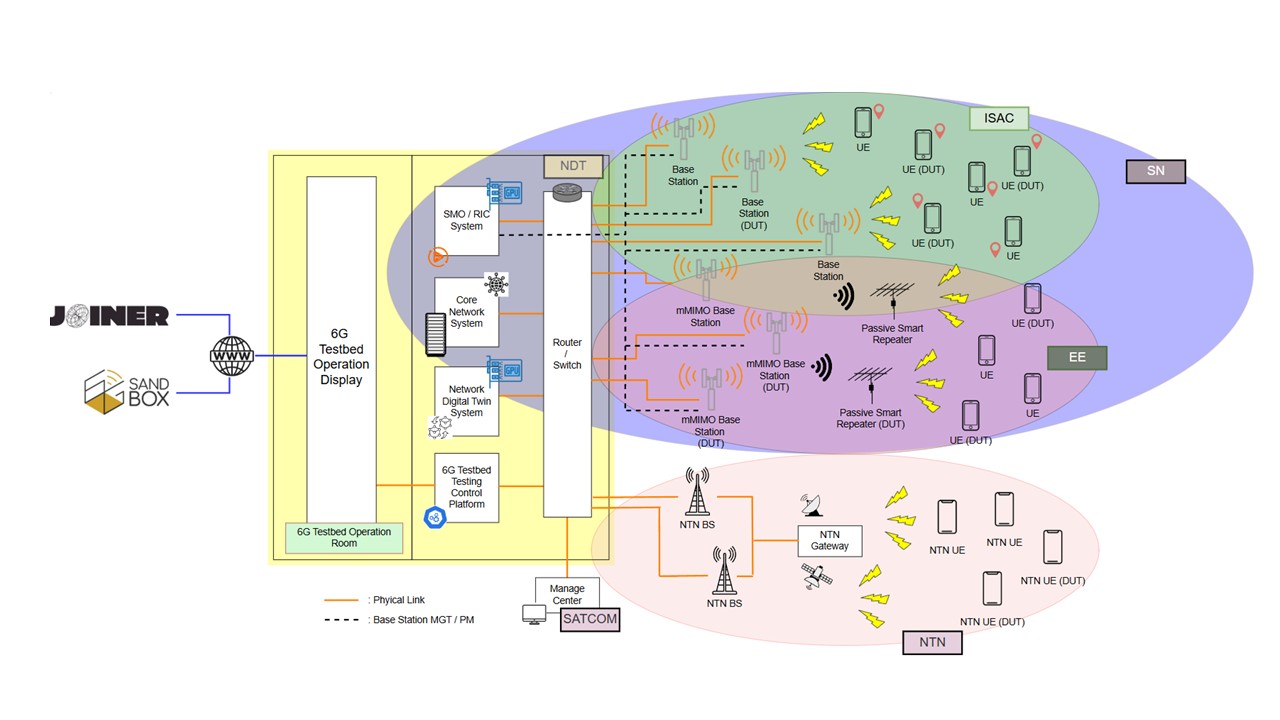
6G-FORMOSA is Taiwan’s first experimental 6G trial network. Led by the Industrial Technology Research Institute (ITRI) and developed in collaboration with domestic research institutes, academia, and telecom industry, the platform supports early-stage 6G research, technology development, and proof-of-concept (PoC) validation. Its objective is to explore the potential of emerging 6G technologies and enable innovative application scenarios.
The 6G-FORMOSA platform is built upon several specialized subnetworks, including Integrated Sensing and Communication, Energy Efficiency, Intelligent Network, Non-Terrestrial Network, and Multi-Orbit Satellite Communication. These subnetworks provide a flexible environment for automated testing, system validation, and experimentation across diverse 6G technologies.
Through the implementation of a Network Digital Twin, the platform enables horizontal integration of communication data, network resources, and service scenarios. This architecture forms a cross-domain 6G experimental network system and an integrated validation platform for next-generation network technologies.
By providing a comprehensive end-to-end communication and application test environment, 6G-FORMOSA aims to accelerate the development and validation of key 6G technologies in Taiwan while fostering early interoperability and collaboration with international 6G trial networks.
6G-FORMOSA provides a comprehensive suite of automated testing and validation solutions designed to support the development, evaluation, and verification of emerging 6G technologies and applications. The platform integrates multiple specialized test environments to enable end-to-end validation across diverse communication scenarios.
Integrated Sensing and Communication (ISAC)
A dedicated validation platform has been established for ISAC systems, supporting automated testing workflows and generating standardized test reports for devices under test (DUTs). Performance KPIs are defined in alignment with 3GPP specifications. Automated test scripts are designed to support a range of deployment scenarios, including indoor smart factories and outdoor low-altitude drone environments, enabling comprehensive ISAC performance evaluation.
Energy Efficiency (EE)
Automated testing platforms and validation environments have been developed for MIMO and distributed MIMO (dMIMO) base stations, as well as passive intelligent repeater and Reconfigurable Intelligent Surface (RIS) systems. The platform supports outdoor scenario validation for domestic vendors, enabling network element performance testing in wide-area coverage and multipath fading environments, while evaluating key energy efficiency performance metrics.
Intelligent Network (IN)
The platform integrates AI/ML-driven network intelligence, automated network management, and smart network application validation. This environment supports experimentation with AI-native RAN capabilities and contributes to the development of a next-generation communications testbed with strong indigenous R&D capabilities.
Non-Terrestrial Network (NTN)
A 5G-Advanced NTN end-to-end testing and validation laboratory has been established to support integrated satellite-terrestrial communication systems. The LAB provides a gNB–NTN–User Terminal (UT) integrated validation environment, enabling functional and performance testing over real satellite communication links.
Network Digital Twin (NDT)
The platform incorporates a cross-domain NDT system that enables integrated network modeling, monitoring, and validation across both laboratory and field environments. Through a visualized centralized control interface, the system connects distributed test sites and supports dynamic indoor network scenario emulation, enabling a unified cross-domain 6G trial network and integrated validation platform.
Multi-Orbit Satellite Communication
The platform has established Taiwan’s first advanced ground equipment testing laboratory dedicated to multi-orbit satellite communications. The laboratory is designed with reference to international standards, including ITU frameworks, and provides diversified validation environments and satellite link simulation capabilities to support future integrated satellite–terrestrial networks.